

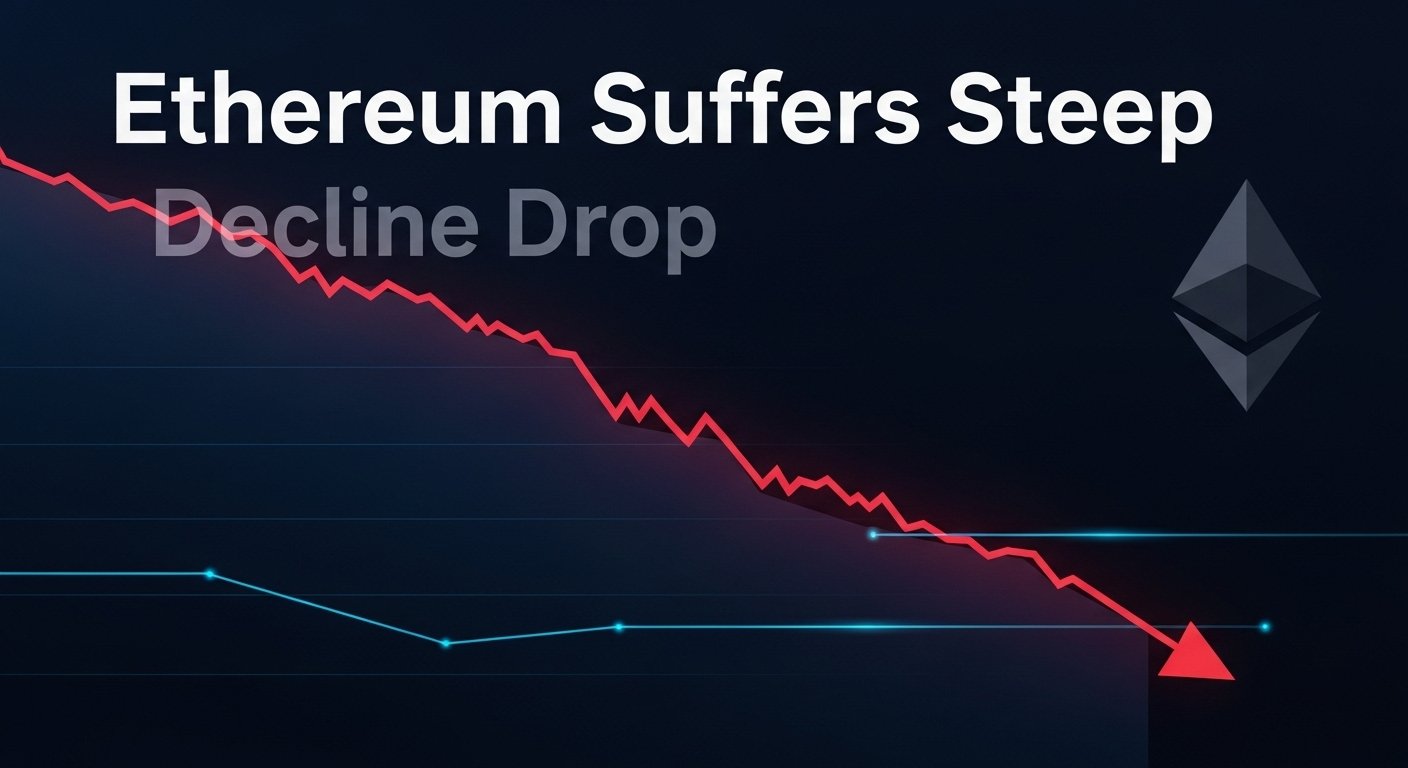
Ethereum Suffers Steep Drop as Liquidations Shake Crypto Market Ethereum has once again found itself at the center of intense market turbulence as prices plunged sharply, triggering a wave of liquidations across major crypto exchanges. The sudden downturn has rattled investor confidence, erased billions in market value, and reignited concerns about broader crypto market stability. As the second-largest cryptocurrency by market capitalization, Ethereum’s price action often serves as a bellwether for the entire digital asset ecosystem. When Ethereum suffers a steep drop, the ripple effects extend far beyond ETH holders, impacting altcoins, decentralized finance platforms, and overall market sentiment.
This latest decline did not occur in isolation. It unfolded against a backdrop of fragile macroeconomic conditions, tightening liquidity, and heightened regulatory scrutiny in key markets. At the same time, excessive leverage in derivatives trading amplified the downside move, leading to a cascade of forced liquidations. As Ethereum prices slid through key technical levels, automated sell-offs accelerated the fall, leaving traders scrambling to reassess their strategies.
Understanding why Ethereum suffers a steep drop as liquidations surge requires a closer look at market structure, investor psychology, and the evolving fundamentals of the Ethereum network itself. We explores the factors behind the decline, the mechanics of liquidations, and what this episode could mean for Ethereum’s near-term and long-term outlook. By examining on-chain data, technical indicators, and macro influences, readers can gain a clearer perspective on whether this downturn represents a temporary setback or a deeper structural challenge for Ethereum.
Ethereum Suffers Steep Drop
Ethereum’s recent price decline unfolded rapidly, catching many market participants off guard. After weeks of consolidation, ETH broke below key support levels, triggering a sharp sell-off that intensified within hours. This sudden move highlighted how fragile market sentiment had become, with traders quick to exit positions at the first sign of weakness.
The broader crypto market was already under pressure before Ethereum’s fall. Bitcoin, often viewed as a market anchor, had shown signs of weakness, and several major altcoins were struggling to maintain momentum. In such an environment, Ethereum’s drop acted as a catalyst, accelerating losses across the board. When Ethereum suffers a steep drop, it often signals a broader risk-off move in the crypto space, as investors reduce exposure to volatile assets.
Macroeconomic uncertainty also played a role. Concerns over inflation, interest rate policy, and global economic growth have weighed heavily on risk assets, including cryptocurrencies. As traditional markets experienced increased volatility, crypto traders became more cautious, leading to thinner order books and greater price swings. This environment made Ethereum particularly vulnerable to sudden shocks.
Another important factor was positioning. Data suggested that many traders were heavily leveraged, betting on a continued price recovery. When Ethereum failed to break higher and instead moved sharply lower, these leveraged positions quickly became unsustainable. The resulting liquidations added fuel to the fire, pushing prices down even further.
What Liquidations Mean in the Crypto Market
To fully grasp why Ethereum suffers a steep drop as liquidations surge, it is essential to understand how liquidations work in the crypto market. Liquidations occur when traders using leverage are unable to meet margin requirements as prices move against their positions. In such cases, exchanges automatically close positions to prevent further losses, often selling assets at market prices.
In periods of high volatility, liquidations can create a feedback loop. As prices fall, more leveraged positions are liquidated, leading to additional selling pressure. This, in turn, drives prices even lower, triggering further liquidations. Ethereum, with its deep derivatives market, is particularly susceptible to this dynamic.
The recent surge in Ethereum liquidations highlighted the risks of excessive leverage. Many traders had taken on aggressive positions, expecting a bullish continuation. When the market turned, these positions were quickly wiped out. Crypto liquidations, especially on large-scale platforms, can reach staggering figures within a short time, underscoring how quickly sentiment can shift.
Liquidations are not inherently negative, as they help cleanse the market of unsustainable positions. However, when they occur en masse, they can exacerbate price declines and increase short-term volatility. In Ethereum’s case, the scale of liquidations suggested that the market had become overly optimistic, leaving little room for error.
Role of Leverage and Derivatives in Ethereum’s Drop
Leverage has become a defining feature of modern crypto trading, and Ethereum is no exception. Futures and perpetual contracts allow traders to control large positions with relatively small amounts of capital. While this can amplify gains, it also magnifies losses, particularly during sharp price movements.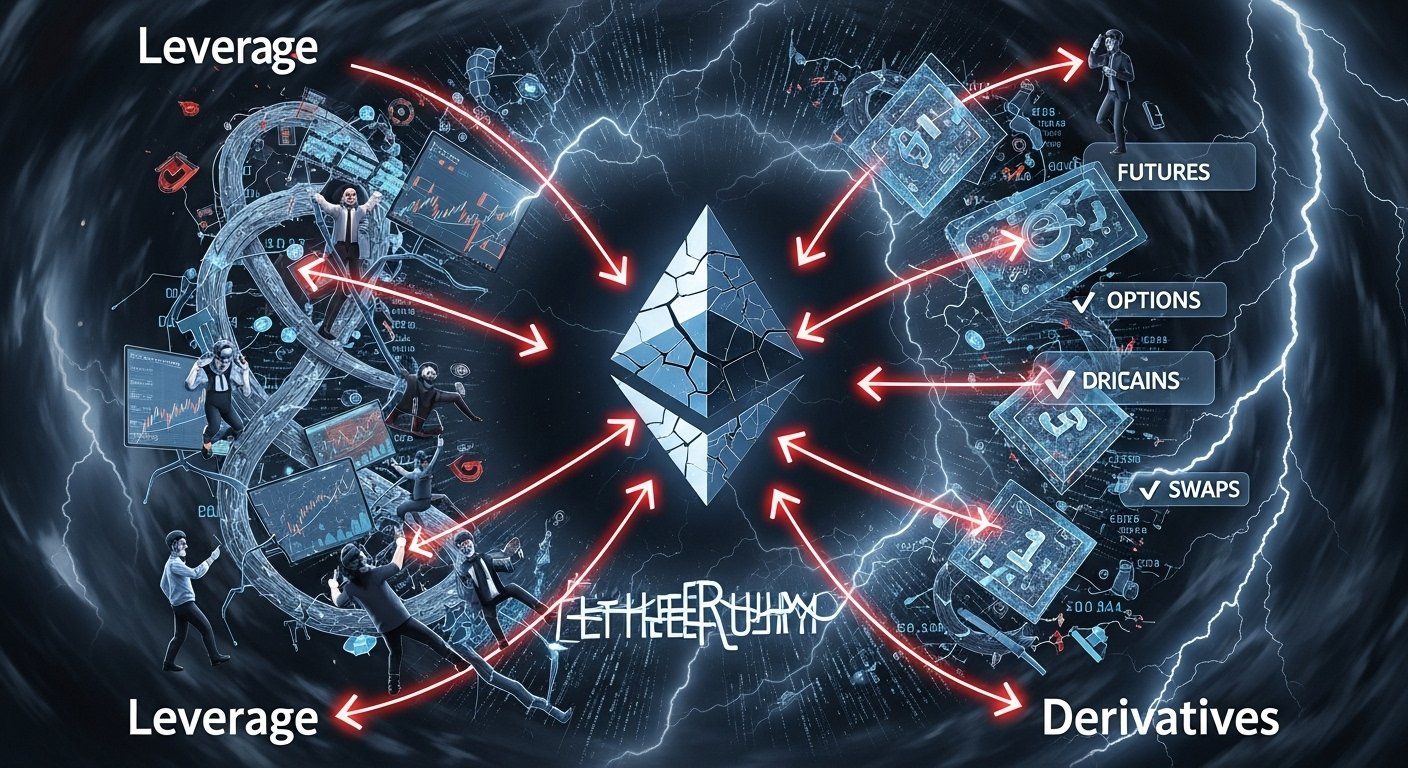
As Ethereum prices began to fall, the high level of open interest in derivatives markets became a critical factor. Many traders were positioned for upside, using leverage to maximize returns. When prices moved against them, margin calls and forced liquidations followed quickly. This chain reaction contributed significantly to Ethereum’s steep drop.
Ethereum price volatility is often intensified by derivatives activity, especially when funding rates and open interest indicate crowded trades. In the days leading up to the decline, funding rates suggested that long positions were dominant. This imbalance made the market vulnerable to a sharp correction. The interaction between spot and derivatives markets further amplified the move. As liquidations occurred in derivatives markets, hedging and arbitrage activity spilled over into spot markets, increasing selling pressure. This interconnectedness means that stress in one segment of the market can quickly spread to others, as seen during this episode.
Technical Breakdown and Key Support Levels
From a technical analysis perspective, Ethereum’s drop was significant because it breached several important support levels. These levels had previously acted as areas of strong buying interest, providing a foundation for price stability. When they failed, it signaled a shift in market structure.
Traders closely watched moving averages, trendlines, and horizontal support zones as Ethereum prices declined. Once these levels were broken, stop-loss orders were triggered, adding to the selling momentum. The speed of the move left little time for buyers to step in, resulting in a near-vertical drop on shorter time frames.
Ethereum technical analysis indicators also pointed to weakening momentum before the collapse. Oscillators showed bearish divergences, and volume patterns suggested distribution rather than accumulation. While these signals are not always predictive, they provided clues that the market was vulnerable to a sharp correction.
The loss of key support levels has implications beyond the immediate price drop. It can alter trader psychology, turning former support into resistance and making recovery more challenging. For Ethereum to regain bullish momentum, it will need to reclaim these levels convincingly, supported by strong volume and positive sentiment.
Impact on DeFi and the Ethereum Ecosystem
Ethereum’s role as the backbone of decentralized finance means that its price movements have far-reaching consequences. When Ethereum suffers a steep drop, the effects are felt across lending platforms, decentralized exchanges, and yield protocols built on the network.
One immediate impact is on collateralized loans. Many DeFi platforms use ETH as primary collateral. As Ethereum prices fall, the value of collateral declines, increasing the risk of liquidations within DeFi systems. This can lead to forced selling of ETH and other assets, further pressuring prices.
The surge in liquidations also affects DeFi liquidation risk, as automated protocols respond to falling collateral values. While these systems are designed to maintain stability, extreme market moves can strain their mechanisms, leading to temporary inefficiencies or increased volatility.
Beyond DeFi, Ethereum’s price drop can influence developer sentiment and network activity. While fundamentals such as network usage and development remain strong, prolonged price weakness can dampen enthusiasm and slow investment in new projects. However, it is important to distinguish between short-term market turbulence and long-term technological progress.
Investor Sentiment and Market Psychology
Market psychology plays a crucial role in episodes where Ethereum suffers a steep drop as liquidations surge. Fear and uncertainty can spread quickly, especially in highly interconnected digital markets. As prices fall, negative sentiment often dominates social media and trading communities, reinforcing bearish behavior.
During this decline, many investors shifted from optimism to caution almost overnight. The speed of the move left little room for rational decision-making, leading to panic selling in some cases. This emotional response is a common feature of crypto markets, where volatility is high and information flows rapidly.
Crypto market sentiment indicators showed a sharp shift toward fear as Ethereum prices dropped. Such extremes in sentiment can sometimes precede short-term bottoms, as selling pressure becomes exhausted. However, they can also signal deeper concerns if underlying issues remain unresolved.
Long-term investors often view these periods differently from short-term traders. While traders focus on price action and technical levels, long-term holders may see sharp drops as opportunities to accumulate. The divergence in perspectives can create tension in the market, contributing to choppy price behavior during recovery attempts.
Macroeconomic and Regulatory Influences
Ethereum’s decline cannot be fully understood without considering the broader macroeconomic and regulatory environment. Global financial markets have been grappling with uncertainty, as central banks navigate the delicate balance between controlling inflation and supporting economic growth.
Rising interest rates and tighter financial conditions tend to reduce appetite for risk assets, including cryptocurrencies. As liquidity dries up, speculative investments become less attractive, leading to increased volatility and downside risk. Ethereum, despite its strong fundamentals, is not immune to these forces. Regulatory developments also influence market sentiment. Ongoing debates around crypto regulation, taxation, and compliance can create uncertainty, particularly for institutional investors. When clarity is lacking, some investors choose to reduce exposure, contributing to selling pressure.
In this context, Ethereum’s drop reflects not only internal market dynamics but also external pressures. Understanding these influences helps explain why price movements can be so abrupt and why recoveries may take time, even when underlying technology remains robust.
On-Chain Data and Network Fundamentals
While price action grabbed headlines, on-chain data provided a more nuanced picture of Ethereum’s health. Metrics such as active addresses, transaction volumes, and staking participation offered insights into how users and long-term participants responded to the decline. Despite the price drop, many on-chain indicators remained relatively stable. This suggested that while speculative traders were exiting positions, core network usage was not collapsing. Ethereum on-chain metrics often help differentiate between panic-driven sell-offs and fundamental deterioration.
Staking data was particularly noteworthy. A significant portion of ETH remains locked in staking contracts, reducing circulating supply. This structural feature can influence price dynamics, as it limits immediate selling pressure from long-term holders. However, it also means that short-term liquidity can be thin, amplifying volatility during sudden moves. These fundamentals suggest that while Ethereum suffers a steep drop as liquidations surge, the underlying network continues to function effectively. This distinction is crucial for investors assessing long-term prospects versus short-term risks.
Comparison With Previous Ethereum Sell-Offs
Ethereum has experienced sharp sell-offs before, each with its own set of drivers and consequences. Comparing the current decline with past episodes can provide valuable context and perspective.
In previous market cycles, Ethereum’s steep drops were often linked to broader crypto bear markets or major external shocks. In some cases, they marked the beginning of prolonged downturns, while in others, they represented temporary corrections within larger uptrends.
What distinguishes the current episode is the scale and speed of liquidations, driven largely by derivatives markets. While leverage has always been part of crypto trading, its prevalence has increased significantly in recent years, making markets more sensitive to sudden moves. This comparison highlights an important lesson: structural changes in market participation can alter how price movements unfold. Understanding these dynamics is essential for navigating future volatility and managing risk effectively.
What This Means for Ethereum’s Short-Term Outlook
In the short term, Ethereum’s outlook remains uncertain. After a steep drop and massive liquidations, markets often enter a period of consolidation as participants reassess positions. Volatility may remain elevated as prices search for a new equilibrium.
Key technical levels will play a critical role in shaping near-term direction. If Ethereum can stabilize and reclaim lost support, it may signal that selling pressure has eased. Conversely, failure to hold current levels could open the door to further downside. Ethereum price outlook also depends on broader market conditions. If macroeconomic pressures persist and risk sentiment remains weak, recovery attempts may face strong resistance. Traders and investors should remain cautious, paying close attention to volume, sentiment, and on-chain data.
Long-Term Implications for Ethereum Investors
For long-term investors, episodes where Ethereum suffers a steep drop as liquidations surge can be both challenging and instructive. Such events test conviction and highlight the importance of risk management and time horizon. Ethereum’s long-term value proposition is tied to its role as a programmable blockchain supporting decentralized applications, smart contracts, and a growing digital economy. Short-term price fluctuations, while painful, do not necessarily undermine this thesis.
However, repeated episodes of extreme volatility can influence adoption and perception. Institutional investors, in particular, may demand clearer regulatory frameworks and more mature market infrastructure before committing significant capital. Balancing these considerations is key for long-term participants. Understanding the difference between market noise and fundamental change can help investors navigate periods of turbulence with greater confidence.
Conclusion
Ethereum suffers a steep drop as liquidations surge, underscoring the complex interplay between leverage, market sentiment, and broader economic forces. The recent decline highlighted the risks of excessive leverage and the speed at which market conditions can change. While the price drop erased significant value and shook confidence, it also revealed important insights into market structure and investor behavior.
Despite the turbulence, Ethereum’s underlying network fundamentals remain resilient. On-chain data suggests continued usage and participation, even as speculative positions were unwound. This distinction offers a measure of reassurance for long-term believers in the Ethereum ecosystem.
As the market digests this episode, caution and perspective are essential. Whether this drop proves to be a temporary setback or part of a larger trend will depend on a range of factors, including macroeconomic conditions, regulatory developments, and the evolution of market dynamics. For now, Ethereum’s steep drop serves as a powerful reminder of both the risks and opportunities inherent in the crypto market.
FAQs
Q: Why did Ethereum suffer such a steep drop during this period?
Ethereum suffered a steep drop primarily due to a combination of weak market sentiment, excessive leverage in derivatives markets, and a breakdown of key technical support levels. As prices began to fall, leveraged positions were forced to close, leading to a surge in liquidations that accelerated the decline and intensified selling pressure across the market.
Q: How do liquidations amplify Ethereum price declines?
Liquidations amplify Ethereum price declines by creating a chain reaction in leveraged markets. When prices fall and margin requirements are breached, exchanges automatically close positions by selling assets. This additional selling pushes prices lower, triggering more liquidations and increasing short-term volatility.
Q: Does this price drop indicate fundamental problems with Ethereum?
The price drop does not necessarily indicate fundamental problems with Ethereum’s technology or network. While market prices declined sharply, on-chain data and network activity remained relatively stable. The decline was largely driven by market structure and sentiment rather than a breakdown in Ethereum’s core fundamentals.
Q: How does Ethereum’s drop affect the broader crypto and DeFi ecosystem?
Ethereum’s drop affects the broader crypto and DeFi ecosystem by increasing volatility, triggering liquidations on decentralized lending platforms, and reducing the value of ETH-based collateral. Since many projects rely on Ethereum, sharp price movements can have cascading effects across the ecosystem.
Q: What should investors consider after Ethereum’s steep drop and liquidation surge?
Investors should consider their risk tolerance, time horizon, and exposure to leverage after such an event. Understanding market dynamics, monitoring technical and on-chain indicators, and focusing on long-term fundamentals rather than short-term price swings can help investors navigate periods of heightened volatility more effectively.
