

Solana Price Prediction as ETF Inflows Surge the conversation around Solana price prediction has intensified in recent weeks as the crypto market witnesses the biggest ETF inflows in months. These inflows are not random retail spikes or short-lived momentum trades. Instead, they appear to reflect calculated positioning by institutions that are gradually building exposure to high-growth blockchain ecosystems. As liquidity returns and sentiment shifts, analysts are asking a crucial question: are institutions positioning for a breakout in Solana?
Solana has long been considered one of the most promising Layer 1 blockchain networks in the digital asset space. Known for its high throughput, low transaction fees, and expanding decentralized ecosystem, Solana has weathered volatility cycles and emerged with renewed developer and investor confidence. The renewed ETF demand adds another layer to the Solana price prediction narrative, especially as institutional capital historically precedes significant market moves.
We explore the forces shaping Solana’s outlook. We will analyze the impact of ETF inflows, institutional accumulation trends, on-chain metrics, technical patterns, macroeconomic conditions, and the broader cryptocurrency market outlook. By the end, you will have a well-rounded perspective on whether Solana is gearing up for a breakout and what that could mean for future price action.
Solana Price Prediction as ETF Inflows Surge
The recent surge in ETF inflows has become a central theme in the Solana price prediction debate. Exchange-traded funds tied to digital assets provide regulated access for institutions and traditional investors who may not want direct exposure through crypto exchanges. When ETF inflows rise significantly, it often signals growing institutional confidence in the broader digital asset class.
ETF flows are important because they represent sustained capital rather than speculative short-term trading. Institutional allocators, pension funds, and asset managers typically enter positions based on long-term outlooks rather than emotional market swings. As ETF inflows reach their highest levels in months, it suggests that sophisticated investors may see upside potential in major crypto assets, including Solana.
For Solana price prediction models, ETF inflows act as a demand-side catalyst. Increased capital inflow strengthens liquidity conditions and can create a supply-demand imbalance, especially if circulating supply remains relatively stable. In past cycles, similar inflow patterns preceded strong upward momentum across large-cap digital assets.
Institutional Positioning: Are Smart Money Investors Accumulating SOL?
Institutional participation is a defining feature of maturing markets. In the context of Solana price prediction, understanding institutional positioning is essential. Large investors often accumulate during consolidation phases, building exposure quietly before broader market recognition triggers a breakout.
Recent data points toward growing institutional interest in digital asset investment products. While Bitcoin and Ethereum remain primary allocations, Solana is increasingly viewed as a high-beta alternative with strong ecosystem fundamentals. As institutions diversify within crypto portfolios, Solana benefits from its reputation as a scalable, developer-friendly network.
Institutions typically evaluate long-term fundamentals, including network performance, developer activity, user growth, and ecosystem expansion. Solana’s recovery in network reliability, combined with expanding decentralized finance and NFT activity, enhances its investment appeal. When ETF inflows rise concurrently with improving fundamentals, the Solana price prediction narrative becomes more compelling.
Technical Analysis and Breakout Potential
From a technical perspective, Solana price prediction scenarios often revolve around breakout patterns. Markets tend to move in cycles of consolidation followed by expansion. When institutional capital enters during consolidation, it can compress volatility before triggering a strong directional move.
Solana’s price structure in recent months has shown signs of accumulation zones forming at key support levels. These zones reflect areas where buyers consistently absorb selling pressure. Technical indicators such as moving averages, relative strength index trends, and volume profiles suggest that momentum may be building beneath the surface.
Breakout potential increases when resistance levels are tested multiple times. Each retest weakens seller conviction. If ETF inflows continue to strengthen overall market liquidity, a decisive break above resistance could accelerate bullish Solana price prediction models toward higher targets.
On-Chain Data and Network Fundamentals
Beyond charts, Solana price prediction relies heavily on on-chain fundamentals. Metrics such as active addresses, transaction throughput, staking participation, and total value locked provide insight into real network usage.
Solana’s ecosystem has expanded across decentralized finance platforms, NFT marketplaces, and Web3 applications. Developer activity remains a critical indicator. Sustained developer engagement suggests long-term viability, as new applications attract users and generate transaction demand.
Another important element is staking. A high percentage of staked tokens reduces available circulating supply, potentially amplifying price movements during demand surges. As institutions accumulate and staking participation remains strong, the supply-side dynamic supports bullish Solana price prediction scenarios.
Macro Conditions and Market Sentiment
Macro trends significantly influence Solana price prediction outcomes. Interest rate policies, global liquidity conditions, and investor risk appetite shape capital flows into speculative assets. When macroeconomic uncertainty decreases and liquidity expands, high-growth assets like Solana often outperform.
Investor sentiment has also shifted in recent months. As ETF inflows grow and regulatory clarity improves in certain jurisdictions, confidence in the digital asset market increases. This renewed optimism can create a positive feedback loop, attracting additional capital into large-cap altcoins.
Solana benefits from this shift because it is often categorized as a leading alternative to Ethereum. When risk appetite strengthens, capital rotates into assets with strong growth narratives. In this environment, Solana price prediction models tend to skew more bullish.
Comparing Solana with Other Layer 1 Competitors
Solana price prediction discussions often include comparisons with other smart contract platforms. Competition in the Layer 1 space remains intense, with networks vying for developer attention and user adoption.
Solana’s differentiating factor lies in its high throughput and low fees. These features enable real-time applications, including gaming and decentralized exchanges, to operate efficiently. As transaction volumes increase across the crypto ecosystem, networks capable of handling scale stand out.
Institutional investors evaluate competitive positioning carefully. If Solana maintains or expands its market share in decentralized applications and blockchain scalability solutions, it strengthens long-term bullish forecasts. ETF inflows that indirectly support the broader crypto market can accelerate capital rotation into high-performance networks like Solana.
Historical Cycles and Price Behavior
Studying historical cycles is crucial for refining Solana price prediction models. During previous bull markets, Solana experienced exponential growth driven by ecosystem expansion and speculative momentum. However, it also endured sharp corrections during broader market downturns. One consistent pattern is that strong rallies often begin after prolonged consolidation phases. ETF inflows can serve as early indicators of renewed institutional participation, which historically precedes major price expansions.
While past performance does not guarantee future outcomes, recognizing cyclical behavior helps investors contextualize current conditions. If the present environment mirrors early-stage accumulation phases from previous cycles, the probability of a breakout increases.
Risk Factors and Volatility Considerations
No Solana price prediction is complete without acknowledging risks. Cryptocurrency markets remain inherently volatile. Regulatory changes, network disruptions, macroeconomic shocks, and competitive pressures can alter market dynamics rapidly.
Institutional participation reduces some volatility by adding stable capital, but it does not eliminate risk. Investors must consider downside scenarios alongside bullish projections. If ETF inflows slow or reverse, price momentum could weaken. Furthermore, speculative leverage in derivatives markets can amplify short-term swings. Solana’s high volatility profile means price targets should be viewed within a range rather than as fixed outcomes.
Short-Term vs Long-Term Solana Price Prediction
Short-term Solana price prediction models focus on technical breakouts, volume surges, and momentum indicators. If ETF inflows continue to strengthen and resistance levels break decisively, short-term upside could accelerate rapidly.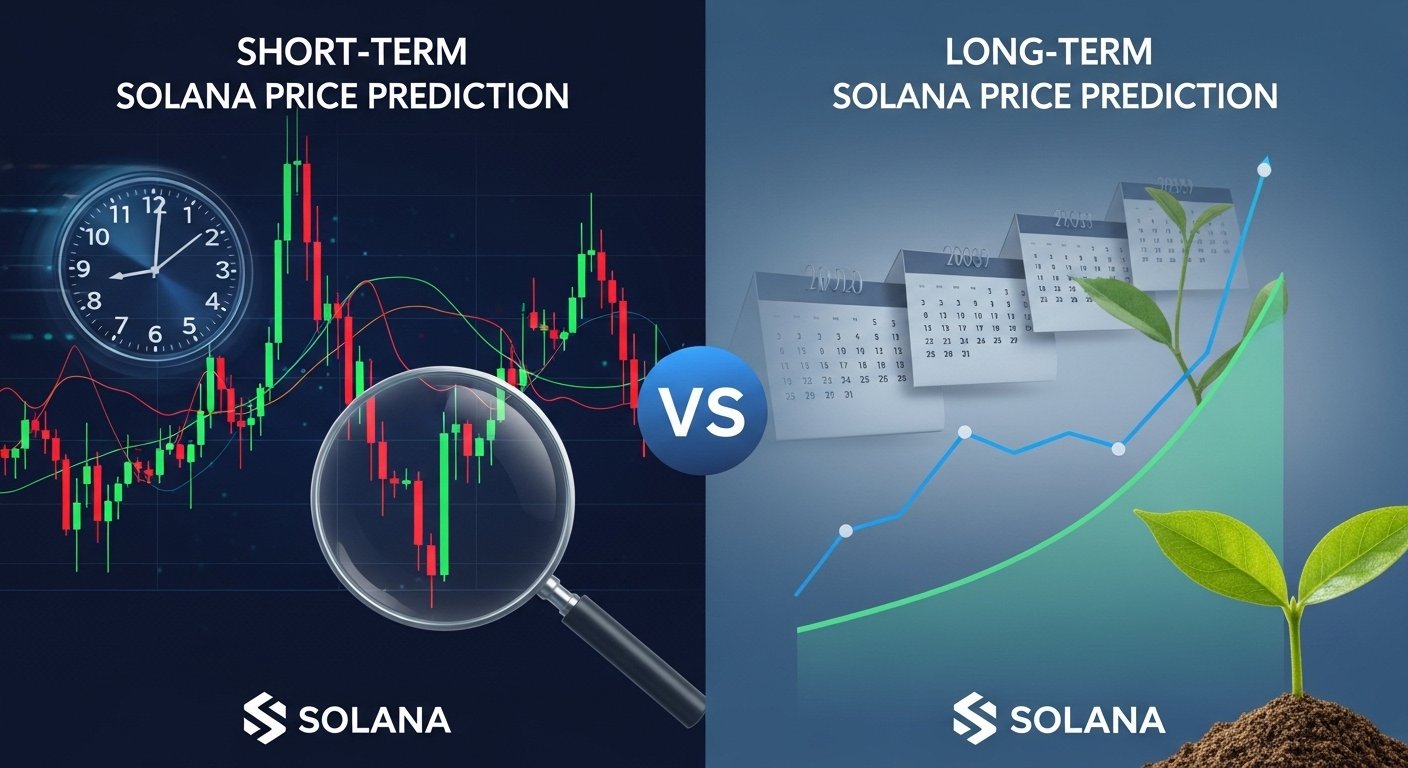
Long-term forecasts depend more heavily on ecosystem growth, developer retention, adoption metrics, and macro conditions. If Solana maintains its technological edge and institutional interest deepens, multi-year projections remain optimistic. Balancing short-term trading signals with long-term fundamental trends provides a more comprehensive outlook. Institutions often adopt a multi-year horizon, which can stabilize price action over time.
Institutional Strategy and Market Psychology
Understanding market psychology enhances Solana price prediction analysis. Institutions often accumulate when sentiment is neutral or skeptical, positioning before broader enthusiasm returns. ETF inflows during relatively quiet market phases may indicate strategic accumulation rather than reactionary buying.
As prices begin to rise, retail investors typically re-enter the market, amplifying upward momentum. This sequence has played out repeatedly in financial markets. If current inflows represent early-stage institutional positioning, Solana could benefit from this familiar pattern. Psychology also influences resistance breakouts. Once a key level is breached, fear of missing out can drive rapid inflows from sidelined participants. Combined with institutional capital, this dynamic can accelerate price appreciation.
Future Outlook: Is a Breakout Imminent?
The question at the heart of every Solana price prediction discussion is whether a breakout is imminent. While no forecast is certain, the convergence of rising ETF inflows, improving fundamentals, institutional accumulation signals, and constructive technical patterns creates a favorable environment.
If macro conditions remain supportive and institutional demand continues, Solana could test higher resistance zones in the coming months. A confirmed breakout would likely attract broader participation, reinforcing bullish momentum. However, patience remains critical. Markets often test conviction before major moves. Consolidation may persist longer than expected before expansion unfolds.
Conclusion
The latest surge in ETF inflows has added significant weight to the Solana price prediction narrative. Institutional capital tends to move strategically, and its return to digital assets suggests growing confidence in the sector’s long-term prospects. Solana’s strong network fundamentals, competitive positioning, and expanding ecosystem make it a compelling candidate for renewed upward momentum.
While risks remain and volatility should be expected, the combination of institutional positioning, improving macro sentiment, and technical accumulation patterns indicates that Solana may be preparing for a breakout phase. Investors should monitor ETF flows, on-chain data, and resistance levels closely, as these factors will likely shape the next major move.
As always, prudent risk management and long-term perspective remain essential in navigating the evolving cryptocurrency landscape.
FAQs
Q: How do ETF inflows impact Solana price prediction models?
ETF inflows influence Solana price prediction models by signaling institutional demand entering the broader cryptocurrency market. When exchange-traded funds tied to digital assets see sustained inflows, it suggests long-term capital allocation rather than short-term speculation. This increased liquidity can support higher valuations across major assets, including Solana. Analysts incorporate ETF flow data into demand projections, as rising institutional participation often precedes significant price movements.
Q: Is institutional accumulation a reliable indicator for a Solana breakout?
Institutional accumulation can be a meaningful indicator, but it should not be viewed in isolation. In Solana price prediction analysis, institutional positioning often aligns with consolidation phases before major breakouts. However, confirmation requires supportive technical signals, macro stability, and continued ecosystem growth. When multiple factors align alongside institutional demand, the probability of a breakout increases significantly.
Q: What technical indicators are most relevant for Solana price prediction?
Key technical indicators used in Solana price prediction include moving averages, resistance and support levels, trading volume patterns, and momentum oscillators. Analysts also watch for accumulation zones and consolidation patterns that precede expansion phases. Breakouts above major resistance levels combined with rising volume often signal strong upward momentum.
Q: What risks should investors consider when evaluating Solana price prediction forecasts?
Investors should consider market volatility, regulatory developments, network performance issues, macroeconomic shifts, and competitive pressures within the Layer 1 ecosystem. Even with strong ETF inflows and institutional demand, external shocks can disrupt price trends. Diversification and risk management strategies are essential when evaluating any Solana price prediction scenario.
Q: Can Solana outperform other Layer 1 blockchains in the next cycle?
Solana has competitive advantages in transaction speed and low fees, which support scalability and user growth. Whether it outperforms other Layer 1 networks depends on continued developer engagement, adoption rates, and macro conditions. If institutional demand remains strong and ecosystem expansion continues, Solana price prediction models suggest it has the potential to outperform during favorable market cycles.
