

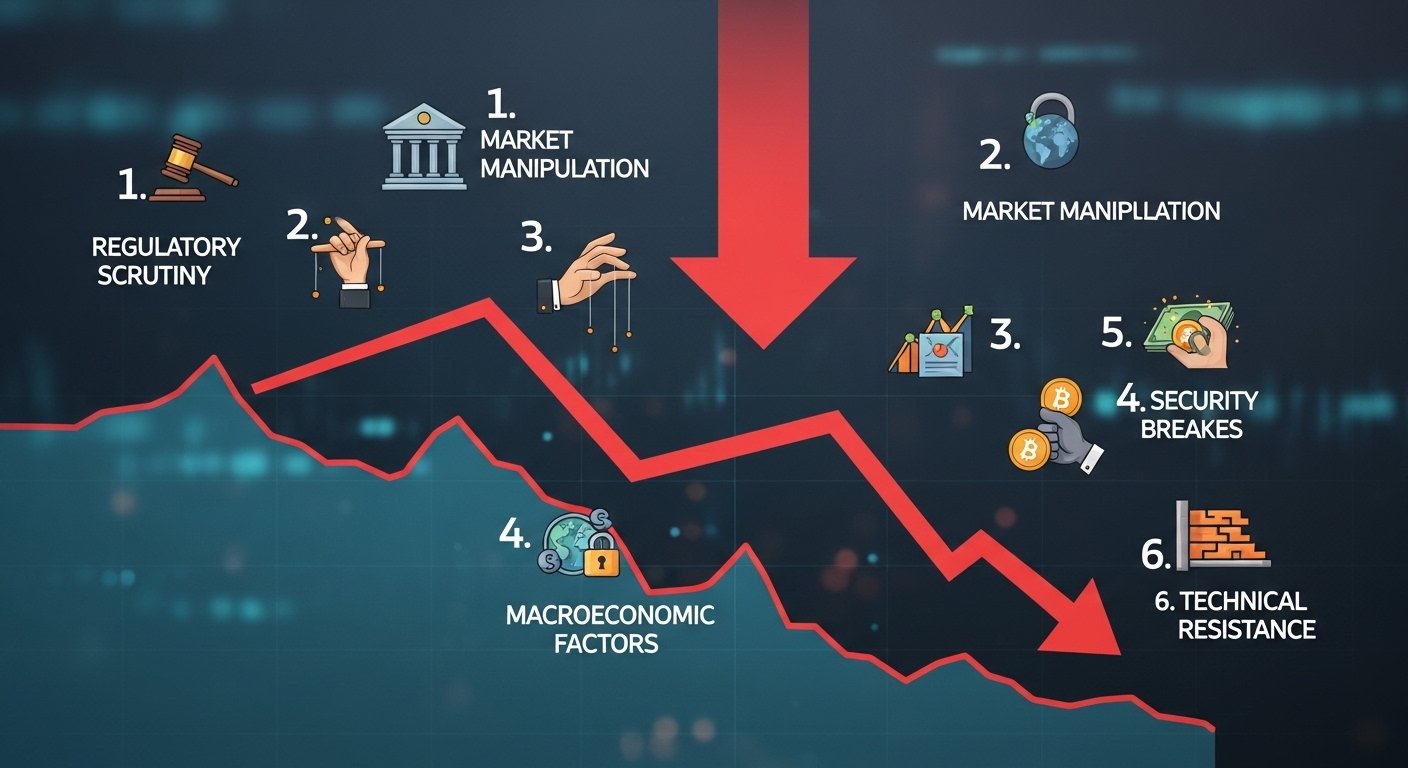
Crypto Down Today 6 Reasons Behind February 2026 Crash the question echoing across trading desks, social media platforms, and investor forums this week is simple yet urgent why is crypto down today? February 2026 has delivered one of the sharpest corrections the digital asset market has seen since the last major bull cycle. From Bitcoin price drops to dramatic altcoin sell-offs, the broader cryptocurrency market has entered a period of intense volatility that has wiped billions from total market capitalization in a matter of days.
Market participants who were celebrating record highs just weeks ago are now navigating a wave of fear, uncertainty, and forced liquidations. The sudden reversal has triggered panic among retail traders, while institutional investors are reassessing risk exposure in an increasingly complex macroeconomic environment. The February 2026 market crash did not happen in isolation. It is the result of several overlapping factors, including global economic shifts, regulatory developments, technical breakdowns, and leveraged trading cascades.
Understanding why crypto is down today requires looking beyond price charts. The digital asset ecosystem is deeply interconnected with global financial markets, regulatory frameworks, and investor psychology. In this in-depth analysis, we explore six major reasons behind the February 2026 crypto market crash and what they mean for the future of blockchain-based assets.
Crypto Down Today 6 Reasons
The first major driver behind the February 2026 downturn is macroeconomic instability. Over the past month, global markets have experienced renewed turbulence due to tightening monetary conditions and weaker-than-expected economic data from major economies.
The Federal Reserve has signaled a more hawkish stance, delaying anticipated rate cuts and reaffirming its commitment to controlling inflation. Higher interest rates generally reduce liquidity in financial markets and make risk assets less attractive. Cryptocurrencies, often categorized alongside tech stocks as high-risk investments, tend to suffer when borrowing costs rise and capital becomes more expensive.
In addition, slowing economic growth in key markets has raised concerns about recession risks. When uncertainty grows, investors shift toward safer assets such as bonds and cash equivalents. This “risk-off” sentiment has hit the crypto market crash February 2026 particularly hard, accelerating sell pressure across major tokens.
Correlation With Traditional Markets
Another factor amplifying the downturn is the increasing correlation between crypto and traditional equities. Over recent years, institutional adoption has tied digital assets more closely to stock market movements. When major stock indices experienced sharp declines earlier this month, crypto followed suit.
This stronger linkage challenges the narrative of cryptocurrencies as completely uncorrelated assets. Instead, the February crash demonstrates how market volatility in traditional finance can spill over into decentralized markets.
Regulatory Crackdowns Create Investor Anxiety
Regulation has always been a key variable in the cryptocurrency industry. In February 2026, new regulatory developments in multiple jurisdictions intensified investor fears and contributed to the sudden downturn.
Authorities in the United States and parts of Europe introduced stricter compliance requirements for crypto exchanges and decentralized finance platforms. Increased scrutiny around stablecoins, staking services, and cross-border transactions created uncertainty about operational costs and legal exposure. For investors, uncertainty often translates into hesitation. The mere possibility of restrictive regulation can trigger widespread selling, especially among short-term traders.
Exchange Compliance Investigations
Reports of investigations into several major crypto exchanges added fuel to the fire. Although no definitive enforcement actions were announced, speculation alone was enough to shake confidence.
When traders begin to worry about liquidity constraints or potential restrictions on withdrawals, panic can spread rapidly. This environment intensified the “crypto down today” trend, pushing prices lower as investors rushed to reduce exposure.
Massive Liquidations in Leveraged Positions
Leverage has become a defining feature of modern crypto trading. While it amplifies gains during bull markets, it can be devastating during downturns. The February 2026 crash triggered a cascade of forced liquidations across futures and margin trading platforms. As prices began to decline, leveraged long positions were automatically closed when they hit liquidation thresholds. This selling pressure pushed prices even lower, creating a self-reinforcing cycle.
The Domino Effect of Liquidation Cascades
When Bitcoin and major altcoins broke key support levels, billions of dollars in leveraged positions were wiped out within hours. Each wave of liquidations added new sell orders to the market, accelerating the drop. This phenomenon explains why crypto can fall so quickly compared to traditional assets. The combination of high leverage and automated trading systems creates extreme price volatility, which was clearly visible during the February market crash.
Technical Breakdown of Key Support Levels
Technical analysis plays a significant role in crypto trading. Many investors closely watch support and resistance levels, moving averages, and trend lines. In February 2026, several major cryptocurrencies broke below critical technical thresholds.
When Bitcoin fell below its long-term support zone, it triggered algorithmic selling and panic among retail traders. The breakdown signaled a potential trend reversal from bullish to bearish, prompting traders to exit positions.
Impact on Altcoins
The effect was even more pronounced in the altcoin sector. Smaller-cap tokens often experience sharper swings due to lower liquidity. As Bitcoin declined, capital rapidly flowed out of altcoins, leading to double-digit percentage losses across multiple projects. This widespread decline contributed to the perception that the entire blockchain market was under threat, intensifying the overall crash narrative.
Profit-Taking After Extended Bull Run
Another important reason why crypto is down today is simple profit-taking. Before the February crash, the market had experienced a prolonged rally that pushed many tokens to multi-year highs. Early investors and institutional funds sitting on significant gains may have viewed the elevated prices as an opportunity to lock in profits. When large holders begin selling, even gradually, it can shift supply-demand dynamics.
Psychological Turning Points
Markets often turn not just on fundamentals but on sentiment. Once traders sense that momentum is fading, they rush to secure gains before prices fall further. This collective shift in psychology can transform a mild correction into a broader sell-off. The February 2026 crypto market crash illustrates how quickly sentiment can change from optimism to fear, especially in an asset class driven heavily by speculation.
Geopolitical Tensions and Market Uncertainty
Global geopolitical tensions also played a role in the February downturn. Escalating conflicts and trade disputes created uncertainty in global financial markets. Cryptocurrency markets, despite being decentralized, are not immune to geopolitical risk. When global instability rises, investors typically reduce exposure to volatile assets.
Safe Haven Debate Revisited
The idea of Bitcoin as digital gold resurfaces during times of crisis. However, the February crash suggests that cryptocurrencies are still viewed primarily as speculative assets rather than safe havens. As geopolitical tensions intensified, capital flowed toward traditional safe assets instead of crypto, contributing to downward pressure.
The Role of Market Sentiment and Social Media
In the age of instant communication, market sentiment spreads rapidly. Negative news headlines, viral posts, and influencer commentary can amplify fear. During the February 2026 crash, trending discussions around “crypto down today” fueled panic among retail investors. Fear of further losses led many to sell impulsively rather than evaluate long-term fundamentals.
Sentiment indicators showed extreme fear levels, reflecting how psychological factors can drive short-term price movements. While fundamentals may remain intact for many projects, perception often dictates immediate market behavior.
What This Means for Long-Term Investors
Despite the sharp correction, it is important to view the February 2026 crypto market crash in context. Historically, the cryptocurrency market has experienced multiple boom-and-bust cycles.
Long-term investors often interpret significant corrections as opportunities rather than catastrophes. Market resets can eliminate excessive leverage, remove speculative excess, and establish healthier price foundations. At the same time, investors should remain cautious. Increased regulation, macroeconomic uncertainty, and evolving market structures suggest that volatility may persist in the near term.
Could the Crypto Market Recover?
Recovery depends on several factors. A stabilization in global macroeconomic conditions, clearer regulatory guidance, and renewed institutional inflows could help restore confidence.
If Bitcoin reclaims key technical levels and trading volumes stabilize, the market could gradually rebuild momentum. Historically, periods of extreme fear have sometimes preceded strong rebounds. However, patience is essential. The February 2026 crash underscores the importance of risk management and diversification in digital asset investing.
Conclusion
The question “why is crypto down today” reflects more than just a single-day decline. The February 2026 market crash is the result of multiple converging forces, including macroeconomic tightening, regulatory uncertainty, leveraged liquidations, technical breakdowns, profit-taking, and geopolitical tension.
The cryptocurrency market remains highly dynamic and sensitive to global events. While the short-term outlook may appear uncertain, history suggests that volatility is an inherent feature of digital assets. Investors who understand the broader context behind the crash are better positioned to navigate the challenges ahead.
As the market digests recent developments, the focus will shift toward recovery signals, regulatory clarity, and macroeconomic trends. Whether February 2026 marks a temporary correction or the start of a prolonged downturn will depend on how these factors evolve in the coming months.
FAQs
Q: Why is crypto down today in February 2026?
Crypto is down today primarily due to a combination of macroeconomic tightening, regulatory uncertainty, and large-scale liquidations of leveraged positions. The February 2026 crash was intensified by technical breakdowns in major cryptocurrencies like Bitcoin, which triggered algorithmic selling and panic among retail investors. Additionally, global market volatility and geopolitical tensions contributed to a broader risk-off environment, pushing investors away from high-risk assets such as cryptocurrencies.
Q: Is the February 2026 crypto market crash worse than previous crashes?
While the February 2026 crypto market crash has been sharp, it is not unprecedented in the history of digital assets. The cryptocurrency market has experienced significant downturns in previous cycles, often following extended bull runs. What makes this crash notable is the combination of macroeconomic pressure, institutional participation, and high leverage levels, which amplified the speed and scale of the decline.
Q: Will Bitcoin recover after the February 2026 crash?
Bitcoin’s recovery will depend on broader economic conditions, investor sentiment, and regulatory clarity. Historically, Bitcoin has rebounded from major corrections, often reaching new highs in subsequent cycles. If macroeconomic conditions stabilize and institutional confidence returns, Bitcoin could regain momentum. However, short-term volatility may continue as the market absorbs recent shocks.
Q: Should investors sell or hold during a crypto market crash?
The decision to sell or hold depends on individual risk tolerance, investment horizon, and financial goals. Long-term investors often view market crashes as opportunities to accumulate assets at lower prices, while short-term traders may prioritize capital preservation. It is important to assess personal financial situations carefully and avoid making impulsive decisions driven by fear.
Q: What lessons can investors learn from the February 2026 crypto crash?
The February 2026 crash highlights the importance of risk management, diversification, and cautious use of leverage in crypto trading. It also underscores how interconnected the cryptocurrency market has become with global economic conditions and regulatory developments. Investors should stay informed, maintain realistic expectations about volatility, and focus on long-term strategies rather than short-term speculation.
